An internal FAQ chatbot and a public website chatbot may share the same chat interface, but they are not the same system. One is built for operational clarity and internal efficiency. The other is built for conversion support, self-service, and customer guidance. If you mix them together, both use cases tend to perform poorly.
What you’ll learn
- The practical difference between internal FAQ chatbots and website chatbots
- Why they should not share the same design by default
- What changes in answer style, handoff, and KPIs
- How to separate scenarios when using ChatBuilder
Bottom line
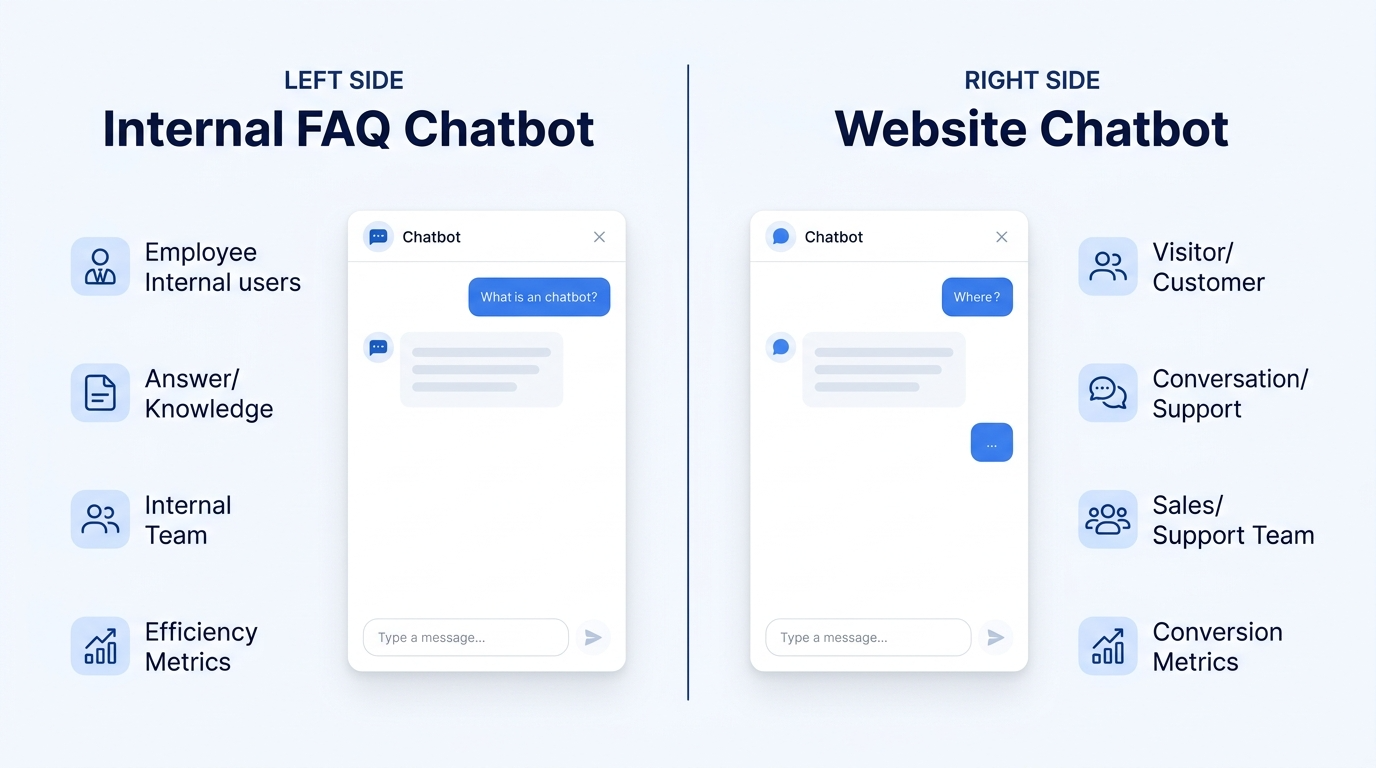
Internal FAQ chatbots are built for retrieval and process support. Website chatbots are built for inquiry deflection, conversion support, and user guidance. Because the users, risks, and success metrics differ, you should not use the same scenario structure for both without adaptation.
Comparison table
| Area | Internal FAQ chatbot | Website chatbot |
|---|---|---|
| Primary goal | Efficiency and internal support | Conversion support and self-service |
| Main users | Employees, internal teams | Prospects and customers |
| Typical questions | Policies, procedures, internal requests | Pricing, setup, features, contact flow |
| Failure impact | Confusion and process errors | Drop-off and lost opportunities |
| Handoff destination | Internal owner or department | Form, phone, email, sales/support |
Difference 1: User intent
Internal users already understand the company context. They need fast, exact answers. Website users may still be evaluating your product or service, so they often need comparison help, reassurance, and guidance to the next step.
Difference 2: Answer design
Internal FAQ chatbots prioritize accuracy and procedural clarity. Website chatbots need to balance accuracy with persuasion, qualification, and clear next actions.
Typical content focus
- Internal FAQ chatbot: procedures, deadlines, ownership, eligibility
- Website chatbot: pricing, use cases, implementation fit, inquiry guidance
Difference 3: What happens when the bot cannot answer
If an internal chatbot fails, the next step is usually a department contact or workflow owner. If a website chatbot fails, the next step must prevent abandonment: a form, phone call, email path, or human support channel.
Difference 4: KPIs
These two chatbot types should never be judged by the same success metrics.
Internal FAQ chatbot KPIs
- Reduced repetitive inquiries
- Self-resolution rate
- Active internal usage
- Unanswered question volume
Website chatbot KPIs
- Chat start rate
- Conversion from chat
- Handoff click rate
- Reduction in support or inquiry friction
Why a shared design often fails
Internal content assumes company context. Website content must explain that context from scratch. A single scenario often becomes too vague for employees and too dense for prospects.
Using ChatBuilder for both
With ChatBuilder, the safer approach is to separate scenarios by use case.
- Internal scenario: policy lookup, process guidance, owner routing
- Website scenario: FAQ, comparison support, contact guidance, conversion path
You can still reuse some content foundations, but the user journey should be different.
Which one should you build first?
Start where measurement is clearest.
- If internal teams receive repetitive procedural questions, start with internal FAQ
- If your website loses users before inquiry or conversion, start with website chat
FAQ
Can both use cases share the same knowledge base?
Sometimes partially, but not without review. The scenario structure, tone, and escalation logic should still be adapted to each audience.
If ChatGPT works for internal FAQ, can I use the same setup on my website?
Not safely. Internal FAQ is about retrieval and procedural support. Website chat is about pre-sales guidance, conversion support, and next-step design.
Next steps
If you are still deciding which use case matters first, start by clarifying your chatbot design assumptions.