
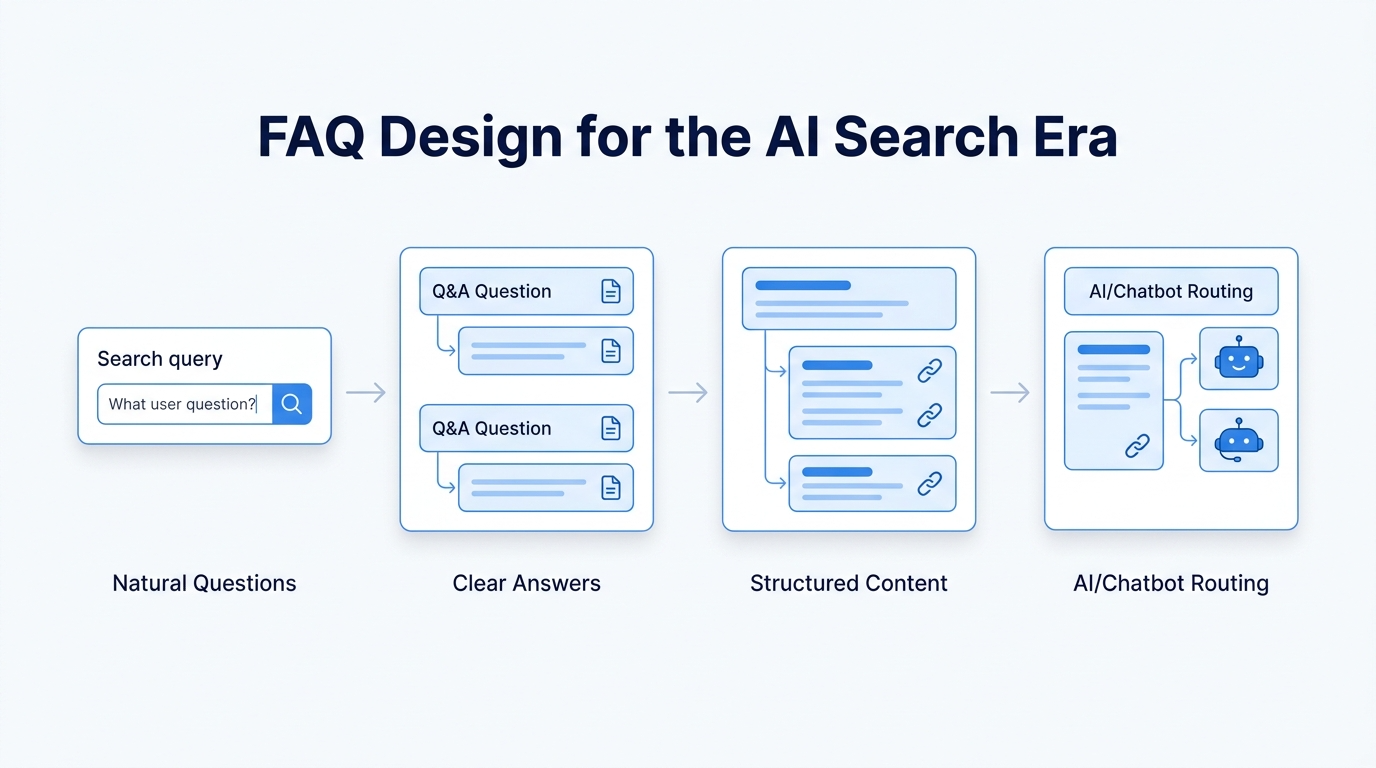
FAQ pages are no longer designed only for people scanning a support page. They are also consumed by search engines, AI systems, and answer-generation interfaces. That changes how FAQ content should be structured, written, and maintained.
What you’ll learn
- What makes an FAQ page easier for AI systems to understand
- How to write stronger question and answer pairs
- Why maintenance matters as much as structure
- How FAQ content should connect with chatbots and deeper pages
Bottom line
In the AI search era, strong FAQ pages use natural question phrasing, direct first-sentence answers, clear supporting detail, and visible maintenance discipline. The goal is not just to publish more questions. The goal is to make answers easy to understand, easy to extract, and hard to misread out of context.
1. Write questions the way users actually ask them
Labels like “Pricing” or “Cancellation” are too vague. Questions should resemble real search phrasing.
Better examples
- How much does it cost per month?
- How do I cancel my subscription?
- What is the difference between the free plan and the paid plan?
2. Put the answer in the first sentence
AI systems may quote or summarize the beginning of the answer. If the first sentence is only context, the extracted result becomes weaker.
Recommended answer order
- Direct answer
- Conditions or exceptions
- Supporting detail
- Relevant next links
3. Keep one FAQ item to one question
If one entry tries to answer multiple related questions, it becomes harder to quote, categorize, and maintain. FAQ content works best when every item has a single clear intent.
4. Treat maintenance as part of design
AI systems do not reliably know whether your content is still current. If your FAQ has no maintenance rhythm, old answers remain visible long after they stop being correct.
Define this early
- Who owns updates
- What triggers revisions
- Whether there is a monthly review process
5. Link out to the right supporting pages
The purpose of an FAQ is not to trap every answer on one page. When a deeper explanation exists, your FAQ should connect users to it.
Typical destinations
- Pricing page
- Terms or policy page
- Setup guide
- Contact or escalation flow
6. Use structured data as support, not as the strategy
FAQPage structured data can help search engines and AI systems understand the page more clearly. But structured data does not rescue weak content. Clear answers and reliable maintenance still matter more.
7. Pair FAQ with chatbot flow design
FAQ content and chatbot flows work best together. The FAQ becomes the stable source of truth, while the chatbot becomes the faster delivery mechanism. With a scenario-based product such as ChatBuilder, good FAQ questions often become strong chatbot entry points.
Design checklist
- Are the questions written in natural language?
- Does the first sentence answer the question directly?
- Does each entry cover one question only?
- Is there an owner for updates?
- Are relevant deeper links available?
- Are FAQ and chatbot roles clearly separated?
FAQ
Is a bigger FAQ always better?
No. A large FAQ with duplication, outdated content, or weak categorization is often less useful than a smaller but better maintained one.
Should answers be extremely short for AI search?
Not necessarily. They should be front-loaded with the answer, then expanded with conditions and supporting detail in a clear structure.
Next steps
Once your FAQ is structured for AI readability, combine it with a chatbot so users can reach the right answer faster.